Monday, June 29, 2015

The Day I Officially Left the Church

   
 So, I wanted to take a break from theology and just share a moment of my life with you.  I know this post may only apply to a handful of people who read it, but it was a big moment for me. But for you people who are looking for some dirty laundry you'll have to find it somewhere else.  SPOILER ALERT: The church didn't excommunicate me.  It was I who went to them and asked to have my name removed from their records.

Anyways, here is how it went down...

     After I became a Christian, the next step was to leave the Mormon church.  I thought that detailed just never stepping foot in their buildings again, but I felt like I needed to go a step further.  I needed to have my name removed from their records.  I didn't want any ties to the Mormon church and as long as they considered me a member (inactive) I felt that I wasn't honoring God.
     Mormons have an extensive church directory.  Every member is documented with things like their birthday, their baptism date, their priesthood authority, etc.  But don't get scared away.  I don't think this is uncommon in churches, nor is this a bad thing.  I would assume they do this so that if their members move or when people pass away the church body can still function.  This record keeping came in handy when I was younger because we moved a lot but never seemed to skip a beat when we got to church Sunday morning.  However, like I said, I felt that the next step in honoring Jesus was to remove my name and my association with a church that I felt was dishonoring to Him and His message.
     The only problem was that I didn't know where to go to get this done.  So, I contacted the missionaries.  I asked them how one would go about removing their name from the Church.  After they tried to convince me not to leave, they said that ultimately I would need to see my bishop.  Now for those of you who are unfamiliar with the LDS church's structure, each member of the Church of Jesus Christ of Latter-day Saints has a home church, called a ward.  Each ward has a bishop that oversees the entire ward.  So, for me to get my name removed from the church, I would need to go see my bishop.  However, this was a problem since it had been years since I stepped into an LDS church I had no idea who my bishop was!
     So I made a few calls...or tried to.  Apparently nobody is at the Mormon church office during the week.  I'm not kidding.  I called once or twice every week or so for months at random times and never got a hold of anybody.  It got to the point that I questioned whether or not I was ever going to get my name removed.  Luckily, I remember that every Wednesday (or Thursday) the LDS church has youth group, which they call Mutual, which the bishop has to attend.  So on the next available Wednesday I decided to go back to church...hopefully for the last time.
     I made the trek over to the church closest to my work and walked to the bishop's office.  Wouldn't you know, he wasn't there.  I then decided to walk around trying to find him...which also proved unfruitful.  After a few minutes of talking to everyone in a suit, I finally found him back in his office.  I asked him if I could have a few minutes of his time, which he obliged.  However, after a few minutes of talking he said that he wasn't able to help me because he wasn't my bishop.  He told me that I needed to go to my home ward and talk to my bishop.  I told him that I had no idea where my home ward even was.  He asked where I lived and whatnot and eventually figured out where I was supposed to go.  I left feeling a bit flustered, but at least I knew where to go next.

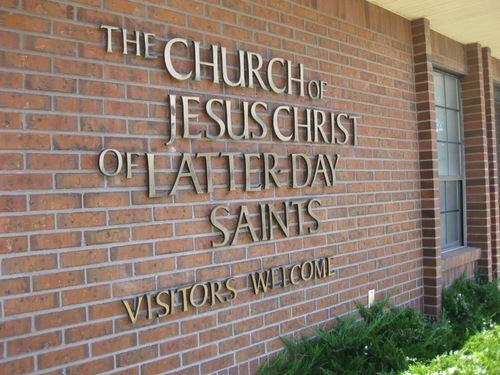
FYI - not the actual meeting we had.
It's just a visual aid.  Move along.
     On my next free Wednesday I headed over to my home ward to meet with my bishop and sat down in a small room.  He sat across from me in a suit and tie and I was completely under dressed.  He was a nice man, probably in his late 30's.  He seemed a bit nervous though.  Maybe he'd not done one of these meetings before or something, I have no idea.  I was actually glad he was a bit shaky because it made me focus less on my rattled nerves.
     We made small talk for a bit.  He asked how I was, where I lived, if I was married or not, things like that.  After a few minutes, he asked why I was there.  I told him that I wanted to be excommunicated.  He kind of looked at me puzzled for a split second, and then asked me why.  I took a breath, and spoke from the heart.  "Well, sir, the main reason is because the Mormon church just doesn't follow the Bible.  The Jesus you guys follow is not the Jesus of the Bible.  I don't believe that Joseph Smith is a true prophet.  I think the Book of Mormon detracts away from the true Gospel of Jesus Christ and I no longer want to be a part of this church."
     My heart was racing and my palms were sweaty as I waited for his response.  He just kind of looked at me and said.  "Ok, well, I'm sorry to hear that."  To be honest, I thought I'd get a different reaction than that.  I don't quite know what I expected, but indifference was not one of them.
     But then he said something that made me stop and think.  "If you get your name removed from the church and are excommunicated, I need you to understand that your baptism, your priesthood authority, your temple recommends, your blessings, and your sealings, and the ordinances I've received/done will all be voided out.  You will not be allowed to pray in church and you will not have the Holy Ghost with you anymore."  Now I knew that I didn't want to be Mormon any longer.  I knew that the LDS church was false.  I knew that their doctrine was in opposition to the Bible.  But when he told me that everything I had done in my 20+ years of being a Mormon would be nullified, I panicked a bit.  It's a weird feeling.  Like I said, I knew they were wrong but was I willing to bet my eternity on it?  After a few seconds (which felt like minutes) I told him I would like to proceed.  He had me sign a paper stating my renouncement of faith and told me that there would be a holding period of 60 days, in which I could renounce my renouncement.
     I left feeling overwhelmed with joy.  I felt like a huge weight had been lifted from my shoulders and that I was finally free.  When I got the letter from the LDS church a few months later, I was so happy!  I wanted to frame it and post it on Facebook, but I thought that would be offensive to some of my friends.  I wanted to shout to the world that I now belong to Jesus and Him only.  Praise God!

     Now, some of you may be reading this and thinking that this isn't that big of a deal.  Leaving a church that you know is wrong should be a no-brainer.  But, it wasn't that simple.  I loved being a Mormon.  I believed it with all my heart.  I got into arguments in school defending my faith, and even tried to convert my girlfriends along the way.  I was a faithful member for 20 years!  To go back on everything I was taught, on what my family raised me up in, what my friends all believed was truly difficult.  Then hearing that everything would be wiped clean, as if it never happened, it was scary.  It became leap of faith for me, and one that I could have never taken if not firmly planed with Jesus.  Thank you God for being my rock, that which all my fears rest on.  Amen.

Monday, June 22, 2015

10 Book of Mormon Faux Paus

     Mormons hail the Book of Mormon as an incredible literary gem.  Latter-day Saint apologists often say that Joseph Smith couldn't have possibly imagined up this sacred text.  I've even heard or read people site that the Book of Mormon has different voices, tones, and varying sentence structures proving that just one man could not have done this.  Not to mention the countless members who would testify of the BOM's beauty and elegance.  Basically, if it was faked then Joseph Smith is the greatest liar in the history of the world.   

How the LDS church illustrates Joseph Smith
translating the  Book of Mormon

Here are a few things people had to say about the Mormon scriptures:

"...the Book of Mormon [is] the most correct of any book on earth, and the keystone of our religion, and a man would get nearer to God by abiding by its precepts, than by any other book."  - Joseph Smith

"No wicked man could write such a book as this; and no good man would write it, unless it were true and he were commanded of God to do so."  - George Cannon

"If Joseph Smith wrote the Book of Mormon, he should be considered one of the great fiction writers of all time.  If he translated it, he should be considered a great prophet."  - Randall A. Wright

How the Book of Mormon was translated according to David Whitmer, and Emma Smith.
Joseph would put the 'seer stone' into a hat, put his face in the hat, and then read the words 
he saw appear in the hat to Oliver Cowdery (or other scribes) out loud, who would write it down. 
(An Address to All Believers in Christ, p.12 & www.lds.org)

     But is it such a fantastic document?  Is it a thing of beauty, awe, and wonder?  I submit to you my rebuttal of such a claim.  Here are 10 things that I find to be either very confusing, blatantly contradictory, or just silly from the purported "greatest book ever written."

1.  Permitted VS commanded
     Mosiah 7:8 reads: "And it came to pass when they had been in prison two days they were again brought before the king, and their bands were loosed; and they stood before the king, and were permitted, or rather commanded, that they should answer the questions which he should ask them."  Permitted means allowed.  Command means directed and ordered.  They are not interchangeable.  So, did the king allow them to answer or command them?  I get confused.

2.  The Flip-Flop
     Alma 10:5 reads, "Nevertheless, after all this, I never have known much of the ways of the Lord and his mysteries and marvelous power.  I said I never had known much of these things; but behold, I mistake, for I have seen much of his mysteries and his marvelous power; yea, even in the perservation of the lives of this people."  The writer of this passage is a man named Amulek,.  According to this verse, he is either unsure of how much he knows God, or just forgot...momentarily.

3. Plenty VS Scarce
     2 Nephi 5:15-16 reads, "And I did teach my people to build buildings, and to work in all manner of wood, and of iron, and of copper, and of brass, and of steel, and of gold, and of silver, and of precious ores, which were in great abundance.  And I, Nephi, did build a temple; and I did construct it after the manner of the temple of Soloman save it were not built of so many precious things; for they were not to be found upon the land, wherefore, it could not be built like unto Solomon's temple.  But the manner of the construction was like unto the temple of Solomon; and the workmanship thereof was exceedingly fine."  The LDS prophet Nephi is teaching his people to use all of these substances which were great in abundance to build another Jewish Temple (something forbidden by Jewish law, but I digress) but the temple wasn't built using these substances because they weren't to be found upon the land.  What!?!?

4. Language Barrier
     Omni 1:14 says that the people of Zarahemla rejoiced "because the Lord had sent the people of Mosiah with the plates of brass which contained the record of the Jews."  So the Zarahemlites(?) were excited because the Mosiahians(?) had a record of God's people.  However, how did they know that is what they were presented with because "Mosiah, nor the people of Mosiah, could understand them."  There was an obvious language discrepency between the two peoples since they could not communicate to each other, yet the people of Zarahemla knew exactly what Mosiah brought them?  It just doesn't add up.

5.  Say Again?!
     The second half of 2 Nephi 4:14 reads, "...many of which sayings are written upon mine other plates; for a more history part are written upon mine other plates."  For a more history part?  What does that even mean?

6.  His Name
     2 Nephi 25:19 reads, "For according to the words of the prophets, the Messiah cometh in six hundred years from th etime that my father left Jerusalem; and according ot the words of the prophets, and also the word of the angel of God, his name shall be Jesus Christ, the Son of God."  But Jesus's last name isn't Christ.  Christ is His title.  It should read "his name shall be Jesus the Christ, the Son of God."  Big difference, and kind of a major theology blunder.  Furthermore, Christ is a Greek word, and this was supposedly written 600 years before the Roman Empire.  They, being the Nephites, were Jewish, so they would have used Messiah, not Christ.

7.  Jerusalem is not Bethlehem
     Alma 7:10 reads, "And behold, he shall be born of Mary, at Jerusalem which is the land of our forefathers..."  Now, I may not know a lot, but I do know that the Bible says he was born in Bethlehem (Luke 2:1-7) which was previously prophesied (Micah 5:2).  Jerusalem is north of Bethlehem by about 5 and a half miles.  They are not the same city, nor can they be confused with each other.  How do you not get this right?  I would assume Mr. Smith had access to a Bible...and Christmas songs.

8.  The Disguise
     The book of Mosiah tells about a prophet named Abinadi, who is telling the people to repent or be destroyed and prophesies that the reign of King Noah is going to end.  King Noah hears of this prophet and seeks him out to kill him.  Which is why, in Mosiah 12:1, two years later "Abinadi came among them in disguise."  But, the weirdest thing happens next.  In disguise, he says "Thus has the Lord commanded me, saying - Abinadi, go and prophesy unto this my people..."  So let me get this straight.  Abinadi was in disguise to go speak to the people, yet the first thing he says is his name!?  Why even wear a disguise then?

9.  No Man Has seen Me
     Ether 3:15 says, "And never have I showed myself unto whom I have created, for never has man believed in me as thou [the brother of Jared] hast..."  But D&C 107:54 says that God appeared to Adam.  Furthermore, Mr. Smith says he saw God and Jesus when he was 14.  Now, some may say that the Bible says that no man can see God and live (Gen. 32:30, Exod. 33:11) but then they can (Exod. 33:20, John 1:18, 1 John 4:12).  But, instead of making this post longer, just read this instead.

10.  Parlez Vous Francais?
     Jacob 7:27 ends with, "...And I make an end of my writing upon these plates, which writing has been small; and to the reader I bid farewell, hoping that many of my brethren may read my words.  Brethren, adieu."  Really?  French?  So, Mr. Smith, you're telling me that a man of Jewish lineage, whose family left Jerusalem and settled in what is believed to be Central America, and who wrote in "reformed Egyptian" actually ended his record by saying Adeiu?  Even though that word's origins are from around 1375-1325 AD.  So Jacob used a word that wasn't going to be invented for another 1,800 years?  Really?  I find that pretty hard to believe.

     So these are the mistakes that I find very interesting, and deflating for the case of the Book of Mormon being the word of God.  False prophecies, word usage, confusing wording, and literal backtracking all make it very difficult to see this as an inspired piece.  Mind you, these are not just improper transitional mishaps or misspellings...well, except for #5, maybe.  But the 9 other ones are pretty substantial mistakes if you ask me.  I'm just sayin'...  

Wednesday, June 17, 2015

Do Baptisms Save?

     If you read the Bible, then it comes as no surprise to know that baptism - to submerge people in water - is a big deal.  In fact, I think it's safe to say that all Bible believing churches baptize their believers.  Jesus was baptized by John (who was known primarily for baptizing believers), the Book of Acts records that thousands of people accepted the gospel and and got baptized (Acts 2:41), the apostles converted and baptized new believers as they proclaimed the gospel, and the list goes on.  So, baptism is one of those things we can all agree on.

...Or is it? *cue dramatic music*


The Christian Viewpoint
     Baptism is a profession of faith.  As my church puts it, it is an outward expression of an inward change.  A person gets baptized because they believe Jesus is the Christ and want to show the world that they have been born again, symbolized as going under the water (old self dying) and coming back out (born again in Christ).  Getting baptized doesn't save you, Jesus does.


The Mormon Viewpoint
     According to LDS.org, getting baptized is "the first saving ordinance of the gospel."  They teach that baptism "is necessary" not only to become a member of their church, but to receive the Holy Spirit and "to receive eternal salvation."  Baptism then is extremely pivotal to a person's eternal destination.  If they are not baptized then they cannot go to heaven.  This is why the LDS believe in the doctrine of baptisms for the dead, in which people who have not had the opportunity to get baptized can have this work done for them by proxy.  Furthermore, only those people who have authority to perform baptisms - the ones ordained with the Mormon Priesthood - can baptize in the name of God.  Lastly, only those who are 8 years old and above can be baptized (D&C 68:27).  This is "power is not given unto Satan to tempt little children, until they begin to become accountable before [the Lord" (D&C 29:46-47).


Baptism And Forgiveness
     When I was Mormon, I was taught that baptism washes away your sins.  The Mormon church uses several verses to teach this doctrine.

(Alma 7:14)
"...therefore come and be baptized unto repentence, that ye may be washed from your sins"

(Acts 2:38)
"Then Peter said unto them, Repent, and be baptized every one of you in the name of Jesus Christ for the remission of sins, and ye shall receive the gift of the Holy Ghost."  

(Luke 3:3)
"And he came into all the country about Jordan, preaching the baptism of repentance for the remission of sins"

(Mark 1:4)

"John did baptize in the wilderness, and preach the baptism of repentance for the remission of sins."

     To some, it may seem that all of these verses teach a clear doctrine that people get baptized in order to receive forgiveness of their sins.  This is what I believed to be true until I started really studying the Bible.

     The Bible says in several places that the blood of Jesus gives the forgiveness of sins and does not mention baptism (Matt. 26:28, Acts 10:43, Rom. 3:25, Heb. 9:22).  If the Bible is true and the inspired word of God, then it should be perfect with no contradictions, as God Himself is perfect.  How then can baptism be how you receive forgiveness of sins but yet only the blood of Jesus gives it to you?  Seems like a contradiction.
     Another example is the story of the thief on the cross.  In Luke 23, the Bible tells a story of a criminal who is on the cross next to Jesus.  Others are mocking and teasing Him, but one man tells them to stop and asks Jesus to remember Him when He is in heaven.  To which Jesus replies, "Truly I say to you, today you shall be with Me in Paradise."  Here is a man who has lived a life according to his own standards and whose actions have landed him in prison and sentenced with capital punishment.  He is not religious, has no ties to any church, yet calls out to Jesus to save him and He does!  Jesus doesn't tell him, "Sorry.  You haven't been baptized, so you can't come with me."  Jesus just responds with, "Come!"  Again, if the Bible is God's word then Jesus just lied to this dude.  But, Jesus doesn't lie...another contradiction!


The Word 'For'
     So what is it!?!?  How can all of these verses be true?  Well, it all centers around the word 'for.'  You see, English is a funny language.  We can use one word to mean many different things, and the word for is no exception.  It has a lot of definitions, but for the sake of time, lets only look at the two that the above viewpoints are using.
  1. To obtain, gain, or acquire - I work 'for' a paycheck.
  2. By reason of; because of - I shout 'for' joy.
     Lets look at Acts 2:38 again.  Using definition 1, I would read it as saying "be baptized everyone of you to obtain forgiveness of sin."  However, as I said earlier, this seems to create a contradiction in scripture.  Let's instead use definition 2.  The verse would then read, "be baptized everyone of you because of forgiveness of sin."  This definition seems to fit more appropriately with the context of other scripture.  In this usage, the blood of Jesus forgives and saves - which is what other scripture states - and as a result, you get baptized.  This is why the Christian Viewpoint is the way it is and why I believe it to be a correct representation of Holy Scripture.  


What Do I Do Now?
     Still not satisfied?  That's okay.  There are a lot of smarter people that have brought this up and explained it a lot better than I just have.  But this is what helped me gain a better understanding of the Gospel.  Like I said, in my head, I couldn't comprehend how LDS doctrine says that getting baptized washes you clean of sin but that it's the blood of Jesus.  Some might say, well that's because they are not mutually exclusive.  Why not both?  Because that's not how the Bible teaches it.   To me, it doesn't make sense to say on one hand "Be baptized for the forgiveness of sin" and then on the other hand say "Jesus died to forgive you of your sins!"  So, I'm forgiven twice?  I'm forgiven through the blood of Jesus and when I get baptized...I'm forgiven again?  Do I need to keep getting forgiven?  Does that mean I should wait until I'm old and finished the majority of my sinning to get baptized?  Does Jesus' blood need help forgiving me of my sins?  This is just a mess!!!
      But, like I said, don't take my word for it.  God gave you a brain, go figure it out on your own.  You've gone this far, now pray and ask God for guidance in your research.  The answers are there if you're brave enough to find them.

Tuesday, June 9, 2015

7 Reasons I Am Not A Mormon

     As you may or may not know, I used to be a Mormon.  I was born a member and left in my early adulthood.  I imagine the Mormon church reacted very similarly to how Gus Portokalos did when his daughter asked to go to college in the movie Big Fat Greek Wedding and he cried out, "Why you want to leave me!?!?"   Ok, not really.  But in all seriousness, people ask me all the time why I left the Mormon church.  Whether Mormon or Christian, Agnostic or Atheist, the reason behind a person's disassociation with a religion is intriguing.  In my book I mainly focus on #7 of this list and provide more detail and context as to why I feel the way I do.  This blog though is not meant to be as detailed.  Should the need arise, I will go into detail on any of the reasons provided below.  But for now, all you get is short, sweet, and to the point.  So, here you go!
     

1.  There are no pastors
     If you go to a Mormon church service you might be surprised to see people from the congregation going up to the pulpit and preaching.  This is because Mormons do not believe in having paid clergy on staff.  Instead, members of the church are regularly called to give 'talks' on a Sunday morning service (a.k.a.- sacrament meeting).  While little children are not asked to give talks, everyone in their teens or above may be asked to speak on any number of topics for that days sermon. But this is not a platform for personal opinions.  Resources, such as previous talks, articles, and commentary by the LDS Prophets and Apostles on the subject are provided and are available for anyone as a guide on what you should say.  This way members don't feel like they have to reinvent the wheel.  While I think giving members an opportunity to serve as volunteers, the position of teaching the church body should be held by those who are more educated in theological studies, hermeneutics, historical contexts, preaching, and mentoring...like a pastor. 


2.  Their faith is based on a feeling
     If belief is the only basis for your faith you're gonna have a bad time.  I have had several conversations with Mormons and that have ended with them saying, "God told me Mormonism was true and there is nothing you or anyone else can say to change my mind!"  I also conducted a survey when I was writing my book a while back in which I asked adult men and women LDS members if they had received a "burning busom" (D&C 9:8-9).  They all said yes.  I then asked on a scale from 1-10 how much their faith depended on that feeling.  They all responded with an 8 or higher, with most of them circling '10'.  I find this to be very interesting and very dangerous.
     If the primary reason to believe something is because you felt good about it, then I suggest you go study some more.  God gave us a brain and He expects us to use it (1 Thes. 5:21).  I have faith that the Bible is the word of God.  And while I have followed James 1:5 and asked God if the Bible is true I also know that there are archaeological, geographical, and historical evidences that validate my faith.  Faith is the filler of gaps between truths, not the other way around.  The smaller the truths, the shakier the faith.  


3.  Mormonism is about religion, not a relationship
     Mormonism is a works based religion.  They believe that in order to get to heaven you need to do certain things (Articles of Faith #3 and #4).  You must be baptized, be married in the temple, pay tithe to the church, follow the word of wisdom...the list goes on.  Religion is when a church gives its members hoops to jump through and in exchange they tell you you'll get to heaven.  Luckily, God is relational.  Jesus already satisfied God's wrath for you on the cross.  All you have to do is have a relationship with Him.  He did all the work because He knew we couldn't.  That's grace, baby!


4.  They believe Book of Mormon is better than the Bible
     2 Nephi reports that God says we are fools if we say "A Bible! A Bible! We have got a Bible, and there cannot be any more Bible...ye need not suppose that [the Bible] contains all my words; neither need ye suppose that I have not caused more to be written." (2 Nephi 29:3, 10).  I understand why Mormons would need to clarify why there is another scripture, but calling people a fool for questioning the validity of that book is kinda harsh.  But it gets worse.  In the introduction of the Book of Mormon, Joseph Smith is quoted as saying, "...the Book of Mormon was most most correct of any book on earth...and a man would get nearer to God by abiding by it's precepts, than by any other book."  To justify the writing of another testament is one thing, but stating that this new publication trumps the Bible is completely false!  That's where I draw the line.


5.  Joseph Smith's false prophecies
     Making false prophecies automatically disqualifies you as being a God's mouthpiece (Deut. 18:20-22).  You can't claim to speak for an all knowing God and then get it wrong.  Here are a few:  He said that Jesus would return before 1891 (History of the Church, Vol 2, pg. 182) which He didn't, that a temple would be built in Missouri within his own generation (D&C 84:2-5) but Mormons were driven out of Jackson County in 1833, that every nation of the world would be involved in the American Civil War (D&C 87:1-3) but history will tell you that every nation did not join the war, and he prophesied that David W. Patten would go on a mission (D&C 114:1) who ended up dying later that year thus never going on a mission in the following spring.  


6.  The lack of evidence to substantiate the Book of Mormon as a historical document
     To date, there is no archaeological, geological, or historical evidence to support the claim that Jews came from Israel, settled in the Americas, and are the ancestors of the Native Americans.  None.  There are no evidences of the wars depicted in the text, nor the animals described, nor the plants and crops grown, nor the buildings or temples talked about.  There is nothing.  On the question of whether or not it is possible that the events described in the Book of Mormon taking place but leaving no traces behind, scientists responded with, "Absolutely not." (For more info, please read this or watch this).


7.  The Mormon Jesus is not the Biblical Jesus
     Mormons do not believe in the Holy Trinity (3-1) but believe that Jesus and God are two separate beings (lds.org).  They believe Jesus was created (D&C 93:21).  They believe that Jesus and Satan are brothers (Mormon Voices).  These and other doctrines regarding salvation, history, His authority and divinity do not describe the Jesus of the Bible.  Jesus is not a God, but the God.  Emmanuel means "God with us."  Jesus was not created for God is eternal.  He is the great I AM.  Jesus is not Satan's brother, but rather his creator.  The bible says all things were made by Jesus (Col. 1:16).  Clearly, we are not talking about the same Guy. 


     There you have it internet.  As always, I'd love some feedback on this.  So if you've got a question, a comment, a complaint, a story, a bone to pick, or just some time to spare, leave me a message.  Have a great day.

Monday, June 1, 2015

Overview - The Book of Abraham

"Abraham and Isaac" by Titian
Located in the church of Santa Maria della Salute
Venice, Italy


     For those of you who don't know, the Pearl of Great Price is a collection of writings, translations, and testimonies written by Joseph Smith.  It is recognized as a standard work of the Church and today is one of the four scriptures used by the Mormon Church.  It contains an excerpt from Joseph Smith's translation of the Old Testament book Genesis (The Book of Moses), his translation of an ancient Egyptian papyri (The Book of Abraham), an excerpt from his translation of the New Testament book Matthew (Joseph Smith - Matthew), a section that covers his testimony and history (Joseph Smith - History), and the LDS statements of faith (The Articles of Faith of The Church of Jesus Christ of Latter-day Saints).  Eventually I would like to discuss each of these books, but for now I will be dealing with the 2nd book of the Pearl of Great Price, namely the Book of Abraham. 
     A while ago, I decided to re-familiarize myself with this book as it had been a while since I picked it up.  Also, now being removed from the LDS church, I was curious to see how my new perspective would play out while reading it.  If you would like to read it for yourself, I would encourage you to do so.  It is a fairly quick read and would provide a lot of context to what I will be talking about.  You can read the entire book here.

     This book seems to fit in around the end of Genesis 11 and the beginning of chapter 12, as it starts off by providing some background as to why Abraham felt he had to leave the land of Chaldea.  The text says that the Chaldeans were evil idolaters (v. 6) practicing human sacrifices (v. 8-11) and that the priests tried to kill him as well (v. 12).  But God delivered Abraham from them (v. 15) and told Abraham of His great plan for him (v. 16-19).  This all gives context to why God told Abraham in Genesis 12:1 to leave his country.  

WHAT'S MY NAME AGAIN?
     One thing I found peculiar is that the Book of Abraham, which is claimed to have been penned by Abraham himself, is his name.  In the LDS text, Abraham refers to himself as "Abraham" (Abr. 2:2).  Now, recall in your Bible that during this time his name was Abram, not Abraham.  God would not change his name for another 15 or so years.  Now it is possible that Abraham wrote this book post-name change and therefore just inserts his new name into the story, but to me this doesn't seem to be a plausible explanation.  Here is why.
     Let me put it in perspective.  At 75 years old, Abram set out from Harran (Gen 12:4) with Sarai, Lot, and his crew.  He then traveled through Canaan, built an altar to the Lord for telling him that his offspring will possess this land, went to the hills east of Bethel, built another alter, entered Egypt and lied about Sarai being his sister,  traveled to Negev, traveled to Bethel, parted ways with Lot, walked “through the length and breadth of the land” (Gen 13:17) that God was going to give to him and ended up at Hebron, heard about Lot’s capture and took three-hundred and eighteen men as far as Dan, fought these men and then pushed them back as far as Hobah (North of Damascus), received blessings from Melchizedek king of Salem (who called him ‘Abram’), God tells Abram that he will have an heir of his own flesh and blood (Gen 15:4-5), he has a vision about his descendants, Sarai gives Abram her servant Hagar to sleep with, a year later – after Abram turns 86 - Ishmael is born, and then four more years happen.  After all of this happened, God changes his name to Abraham (Gen 17:1-5).  So after 90 years, he writes this book and just uses his new name with no mention of the change?  Now, remember this is a Joseph Smith Translation, which means that the Book of Abraham could theoretically be inserted into Genesis 11-ish.  However, since the "name-timeline" does not match up it does not work.
     Not to mention the significance of the name change itself.  God changed his family name.  That is HUGE!  Back then, your name was your birthright.  It was purposefully given to you by your fathers.  In the Bible, all the names mean something, so to change something so valuable as a name is a huge deal!  This is why the Bible makes clear that the Big Guy made the call, so it's cool.  The Book of Abraham, on the other hand, just disregards his former name and goes on as if nothing happened.  
     Again, this may not be 'proof' of anything, but it is something that I find very peculiar.   

NO, NO, NO.  SHE'S MY SISTER!
      According to this book, God tells Abraham “Behold, Sarai, thy wife, is a very fair woman to look upon; Therefore it shall come to pass, when the Egyptians shall see her, they will say – She is his wife; and they will kill you, but they will save her alive; therefore see that ye do on this wise: Let her say unto the Egyptians, she is thy sister, and thy soul shall live.” (Abr. 2:22-24).  There are a few problems that I see with this account of Abraham’s life.  
     The first is that God, or more specifically Jehovah (v. 8), tells Abraham to lie.  This is a contradiction to the very nature of God.  God cannot lie (Titus 1:2) and He specifically commands us all to not tell false stories about one another (Exodus 20:16).  Why would God command his prophet to sin?  Remember that our God is Holy, Holy, Holy (Isaiah 6:3, Rev. 4:8).  That means He is pure and completely righteous.  Sin cannot even escape His mouth because it has no place in Him.  The idea that God would command His servant, the one through which the entire world would be reconciled to Him through, to sin is very difficult to believe.
     Secondly, the Bible says that after Pharaoh took Sarai into his palace the Lord inflicted serious diseases on him and his household “because of Abram’s wife Sarai” (Gen 12:17).  God allowed pain and suffering to be inflicted upon Egypt because they took the woman who God was going to establish His covenant with.  God was clearly not on board with the idea of claiming Sarai was his sister and made it known to everyone so that nothing could come from it.  Look at Pharaoh’s response. “Why didn’t you tell me she was your wife?  Why did you say ‘She is my sister,’ so that I took her to be my wife? Now then, here is your wife.  Take her and go!” (Gen 12:18-19).  He is so upset that he was being punished by God for stealing a woman he had no idea was already taken.  He wants nothing to do with them and just orders them to get all their stuff and leave.  This begs the question as to why God would command Abraham to lie when it seems like they had nothing to worry about in the first place.
     Biblically speaking, Abram was the one who came up with the idea of lying out of fear.  It was not God's plan.  “I know what a beautiful woman you are.  When the Egyptians see you, they will say, ‘This is his wife.’ Then they will kill me but will let you live.  Say you are my sister, so that I will be treated well for your sake and my life will be spared because of you.” (Gen 12:11-13).  Abram told Sarai to lie because he feared for his life.  He didn’t trust God enough to protect him, so he took matters into his own hands. 
     Lastly, what did Abram get from the lie?  He didn’t receive any gold, or silver, or livestock, or power, or land, or servants, or women, or anything like that.  After the exchange, the Bible says that he took all that he had and left.  Pharaoh didn’t pay him to leave or anything, he just left.  So, say for arguments sake, that God did command Abram to lie.  What was the purpose?  Did God just want to inflict the Egyptians with diseases for a few hours/days/however long they were there for out of spite?  That seems pointless and counterproductive coming from a God who is perfectly purposeful.  

URIM AND THE THUMMIMMIMM....MIM
     Abraham learns about several things through the use of the Urim and the Thummim (Abr. 3:1).  Biblically speaking, the “Urim and the Thummim” are referenced several times in the OT, but they occur a bit later in time than where we are in this story.  In Exodus 28:30, they were attached to the breastpiece of the priestly garments so that Aaron would have the means to make decisions for God’s people.  It was even used to obtain answers for the Israelites (Num. 27:21, Neh. 7:65, Ezra 2:63, 1 Sam. 14:41, 1 Sam. 28:6).       Again, this is not 'proof' of anything, per-say.  It's just something I find odd.

PLANETS AND STARS
     Planets and stars are mentioned that modern Astrology has not been able to locate, which is saying a lot.  Celestial bodies such as Kolob which “according to its times and seasons in the revolutions thereof; that one revolution was a day unto the Lord, after his manner of reckoning, it being one thousand years according to the time appointed unto that whereon thou standest.  This is the reckoning of the Lord’s time, according to the reckoning of Kolob” (Abr. 3:4).  Furthermore, Kolob “is set nigh unto the throne of God [or God’s home], to Govern all those planets which belong to the same order as that upon which thou standest [Earth] (Abr. 3:9) There are other heavenly bodies mentioned in this text as well, such as the star Kokob, the moon Olea, and the stars Kokaubeam that are not recognized by the scientific world.
     Now, to be fair, modern science doesn't know everything.  So it is possible that these planets do exist but they have yet to be discovered.  However, it is also possible that these planets have never existed and are complete fabrications.  I'll let you decide on which.  

ANOTHER CREATION STORY?
     Abraham 3:21-5:21 discusses specifics of God's creation of the world.  However, in this text it is more like "the Gods' creation of the world."  These chapters refer to creation being done by "the Gods" and seems to be a dramatized version of Genesis, chapters 1 and 2.  The main difference here is that Abraham uses the plural form "Gods" to denote multiple Gods (polytheism) whereas the Bible refers to God as Elohim (plural form) with singular verbs, denoting a 3-1 God, or the Holy Trinity (monotheism).  For more information on this, which is very illuminating, check this out.  
     So, one book says there are multiple Gods and the other says there is one.  Again, I'll let you decide.  

CONCLUSIONS?
     You're a big boy/girl, you can decide for yourself.  I know what I believe, and I think from my writings and tone you can guess where I am going to land on this issue.  But, to be honest, even if I did tell you, it really wouldn't matter.  It's like I've heard time and time again, "You cannot argue someone into heaven."  Ultimately, you are going to have to look at the facts, at both sides, read it for yourself, and decide.  These are just a few of my findings/ramblings/etc. and I will do my best to post more to give you a broader perspective, but I can only do so much.  

Anyways, that's my two cents.  

Wednesday, May 20, 2015

Which Version of the Bible Should You Use?

It may surprise you to know that the Bible has over 50 different versions of the Bible in English alone!  Many churches and institutions around the world have their favorite version, as do I and am sure you do as well.  For instance, I am currently reading through the NASB version, but I have read the NIV and the NKJV and grew up using the KJV.  But when it comes down to what version should you use, I think the conversation has gotten pretty crazy.  I've heard on podcasts, read on blogs, and heard it from friends alike.  "You have to use the (insert translation) Bible because it is the only true translation!"  I may be wrong - it does happen from time to time - but I think this viewpoint is pretty short sighted.  And with some of the arguments I've heard it seems that people don't really understand how the different versions came about and why they are considered to be reliable/accurate and as such they are honestly not qualified enough to make a claim one way or the other.  They are drawing 'lines in the sand' on this issue but do so out of ignorance and stubbornness.  Some of my Mormon friends/family have said that the only Bible one should read is the King James.  I tend to disagree.  I think there are other translations that are equally reliable in portraying what God wanted us to know.

So, instead of arguing and debating, I decided to just get some information about the other translations out there so you can decide for yourself.


Note 1: The Bible was not written in English.  Shocker...I know!  As such, a lot of the versions we have simply will not perfectly translate.  For instance, the Greeks had several words for "love" while English uses, basically, one.  Not to mention context of history and customs that we in the 21st Century are not familiar with makes it almost impossible to accurately translate the intended meaning and intent of the original writings.  As such, no one version of the Bible can claim to be 100% accurate.  But, with that being said, some versions are considered by scholars, pastors, educators, linguists, historians, etc. as being accurate and true to the original manuscripts.

Note 2: The pros and cons are not exhaustive, nor are they validated/recognized by both supporters and non-supporters of the respective translations.  Some people love their version and attack with great ferocity towards the other ones out there.  Just know, these pros/cons are collections from several different places.

Note 3:  Most of these translations below, with the exception of "the Voice", are considered by the Christian community to be both accurate and reliable.  This does not mean though that some versions that have not received a lot of scrutiny and animosity, because they have.  However, none of these - as far as I could see - were placed in the ABSOLUTELY DO NOT USE category of scripture.

Note 4:  I am not condoning every version of the Bible.  There are some out there that do not accurately translate God's word.  We need to be careful.  Some versions take out key issues and insert their own theology.  Be warned.


According to to the Christian Booksellers Association, the top ten Bible translations for 2014 are below.  I am going to give a brief description of the version and history, and some pros and cons, and the translation of a verse just to show you the difference.

So, lets get to it!

1.  New International Version (NIV)
    • Description/History 
      • The NIV was created about 50 years ago when Howard Long tried to share some scripture with a non-Christian and he thought the King James version didn't connect.  This led him on a journey to create a bible that would appeal to the people of 'today'.  Instead of just updating an existing translation, they decided to start anew and create the NIV.  Before the first publishing in 1978, more than 100 bible scholars to ensure it was without bias or fault.  Today, it still undergoes close scrutiny from a self-governing body of 15 evangelical Bible scholars known as the CBT.  
    • Pros 
      • Most popular choice among churches/individuals
      • Modern English language
      • "thought for thought" translation 
      • Widely respected translation
    • Cons
      • It is shorter than other versions
      • words &/or phrases removed
      • Some say it is too "interpretive"
      • Gender-inclusive language
    • Gal 5:4
      • "You who are trying to be justified by the law have been alienated from Christ; you have fallen away from grace"
2.  King James Versions (KJV)
    • Description/History 
      • In 1604, King James I of England allowed a new translation of the Bible into the English language which was completed in 1611.  The translation was performed by 47 scholars with instructions to guarantee the version would be true to the Christian theological perspectives, the structure of the Church of England, and the belief in ordained clergy.
    • Pros
      • One of the oldest versions written in English
      • Many claim this to be the only reliable version
      • Translated from Textus Receptus
      • Seems to be the version all other versions are compared to
    • Cons
      • Archaic language
      • Difficult to read/understand at times
      • Not translated from the older manuscripts (Codex Sinaiticus and Vaticanus and the Dead Sea Scrolls)
      • Commitment to "complete equivalence" resulting in the concepts behind literal words not being communicated adequately
    • Gal 5:4
      • "Christ is become of no effect unto you, whosoever of you are justified by the law; ye are fallen from grace"
3.  New King James Version (NKJV)
    • Description/History
      • In 1975, the Thomas Nelson Publishers wanted to create a new, modern translation while still retaining the integrity and beauty of the King James version.  So, after seven years, and the input of 130 Bible scholars, the NKJV was created.  Along with trying to stay true to the KJV, this translation also takes into account modern scientific discoveries, as well as linguistic and textual studies.  
    • Pros
      • Easier to read than King James
      • Similar in form to the KJV
      • Traslated from Textus Receptus
      • Footones include the Majority Text and Critical text
      • Essentially literal translation
    • Cons
      • Some of its translators are reported to believe that the Bible was not divinely preserved
      • Not 'true' modern language/still confusing
      • Has changed certain words from the KJV and lost the Bible's true meaning
    • Gal 5:4
      • "You have become estranged from Christ, you who attempt to be justified by law; you have fallen from grace."
4.  New Living Translation (NLT)
    • Description/History 
      • This is a revision of the of the Living Bible.  It is meant to convey the meaning of the ancient Hebrew and Greek texts, the NLT is based on the most recent studies of translating the Bible.  Creators wanted to have a version today that had the same impact on the ancient people.
    • Pros
      • Modern English language
      • "Thought for thought" translation
      • Huge improvement from the Living Bible
      • Makes a good story book
    • Cons
      • Inserts text in places that address or seem to address modern issues
      • Mild tendency in favor of distinctively fundamentalist teachings
      • Too "interpretive" 
    • Gal 5:4
      • "For if you are trying to make yourselves right with God by keeping the law, you have been cut off from Christ! You have fallen away from God's grace."
5.  English Standard Version (ESV)
    • Description/History
      • The ESV "stands in the classic mainstream of English Bible translations over the past half-millennium" (BibleGateway.com).  Each word and phrase was painstakingly compared to the ancient languages so to avoid under-translating, or any nuance that the original manuscripts had.  The ESV was translated by a group of scholars representing a diverse group of denominations and is not affiliated with any denomination or Bible society.  
    • Pros
      • Use the best texts, scholarship, and techniques that are available
      • Essentially literal translation
      • Do not render Greek gender-specific words
      • Dignified
      • Modern English language
      • Endorsed by many Christian leaders
    • Cons
      • Too literal / unelegant
      • Pronouns referring to Deity are not capitalized
      • OT Quotes are not clearly marked
      • Stance on social issues bias
      • Relatively frequent revisions
    • Gal 5:4
      • "You are severed from Christ, you who would be justified by the law; you have fallen away from grace"
6.  Holman Christian Standard Bible (HCSB)
    • Description/History
      • 17 Denominations and 100 scholars studied the ancient texts and translated the HCSB, while keeping true to it's original meaning and intent of each word, phrase, and nuance.  
    • Pros
      • Trusted "Original Translation" by academic standards
      • Uses both "thought for thought" and "word for word" translation methods, where applicable
      • Easy to read
      • Modern English language
      • No gender controversy
      • Readily available
    • Cons
      • Young translation
      • Some translated passages deemed unconventional
      • Unsure of who oversees the revising of present/future translations
    • Gal 5:4
      • "You who are trying to be justified by the law are alienated from Christ; you have fallen from grace."
7.  The Voice (VOICE)
    • Description/History
      • This is a sort of different type of Bible translation.  A collaboration of scholars, pastors, writers, musicians, poets, and artists with the intent of creating a Bible to help believers experience God's word.  Scholars would translate words/sentences/passages and then let the artists mold it into something readable, familiar, accurate, and reliable.
    • Pros
      • Reads like a story
      • Modern English language
    • Cons
      • Paraphrases scripture
      • Not quite translation, but an adaptation/rendition
    • Gal 5:4
      • "You, and anyone else who seeks to be on the right side of God through the law, have effectively been cut off from the Anointed, circumcised from grace, and cast off from the favor of God."
8.  New American Standard (NASB)
    • Description/History
      • A project of the Lockman Foundation with translators from a wide variety of evangelical backgrounds.  The NASB is thought to render as close as possible to the original Greek and Hebrew texts.  It was updated in 1995 to read better and smoother than before
    • Pros
      • Considered the most literal translation
      • Some regard it as the most accurate Bible in English
      • OT quotes in the NT are in all caps
      • Modern English Language
      • Pronouns for deity capitalized
      • Sincere effort not to function as interpretor
    • Cons
      • Follows Greek/Hebrew word order closely making it hard to read
      • Does not fully take advantage of modern translation scholarship
      • Still some archaic expressions/terms
      • Difficult to read aloud
    • Gal 5:4
      • "You have been severed from Christ, you who are seeking to be justified by law; you have fallen from grace."
9.  Reina Valera 1960 (RVR1960)
    • Description/History
      • This text is the most used by the evangelical Spanish-speaking church.  It is the most loved and used because of it's traditional style of the Spanish languag
    • Pros/Cons/Gal 5:4
      • These items will not be discussed because this blog is in regards to the English Translations.
      • I don't speak Spanish
      • I still wanted to include it because it was part of the list and I didn't want to be seen as 'cheating' or 'altering' the Top Ten List.  Some people get weird when you mess with lists.
10.  New International Reader's Version (NIrV)
    • Description/History
      • Based on the NIV, the NIrV is basically a simpler, easier read than the NIV is.  In the process of creating this version parts of the NIV were used when it seemed to 'fit' with this particular translation.  Translators used the best and oldest copies of the Hebrew and Greek manuscripts to ensure that what is contained in the NIrV is accurate and trustworthy.
    • Pros
      • Deemed easiest to understand by most Bible scholars
      • Modern English language
    • Cons
      • Has a reputation for being the Bible for readers with a below-average reading level
      • Too "interpretive"
    • Gal 5:4
      • "Some of you are trying to be made right with God by obeying the law.  You have been separated from Christ.  You have fallen away from God's grace."

So what does this all mean?  Well, that's for you to decide.  Some swear by their KJV.  Others say they feel closer to God using the NIV.  I've heard some say that the NASB is their Bible of choice because they like knowing they have the version closest to the original languages.

For me, this is not an issue to defend to the death.  Even in writing this now, I realize that there are other versions that have done their best to accurately translate God's word into English and I am grateful I have a Bible at home to read, both in my own time and with my family.

If you are buying or looking to buy a Bible, do some research, pray, and just know what you're looking for.  Also, if you're in doubt talk to someone.  I'm sure you can find someone in your relational world that can recommend a version for you.

But that's just my two cents...and I'm broke...so...whatever.

Sources:
www.biblegateway.com/versions
gospelbiblepaths.50webs.com/index_7.html
www.biblehub.com
www.gty.org/resources/questions/QA167/which-bible-translation-is-best
www.wikipedia.com
www.jesus-is-savior.com/Bible/NIV/damnable.htm
www.chick.com/ask/articles/nkjv.asp?FROM=biblecenter
www.gotquestions.org/New-King-James-Version-NKJV.html
christianknight.wordpress.com/2010/11/06/esv-vs-nkjv (or) esv-vs-nasb
www.wels.net/sites/wels/files/Pros%20and%20Cons%20-%20Oct%2015.pdf

Title Change

The name of the blog has changed, though it doesn't seem to be reflecting that when I try to post links, so I'm sorry about that.

I realized that not every post will be about Mormonism and as such having the title "Understanding Mormonism" could be confusing.  To be honest, most of my posts will have something to do with Mormonism - whether in part or whole - so, no real change in content.  However, I may choose to blog about something that seems to transcend both the Christian and Mormon realms, so I thought it best to have a less pigeon holed title.


Also, "Understanding Mormonism" seemed to be a very intimidating.  I didn't want to come off as some guy that is attacking the LDS church.  I would rather come across as someone who is fairly knowledgeable that is just trying to get people from all religions to stop and think.  So instead of saying to the world..."This is what they believe, this is what I believe, and you should know the difference!"  I'm now saying, "Hey, here is something that I'd like to talk about.  What do you think?"  See the difference?


So anyways, just wanted to let you know.